
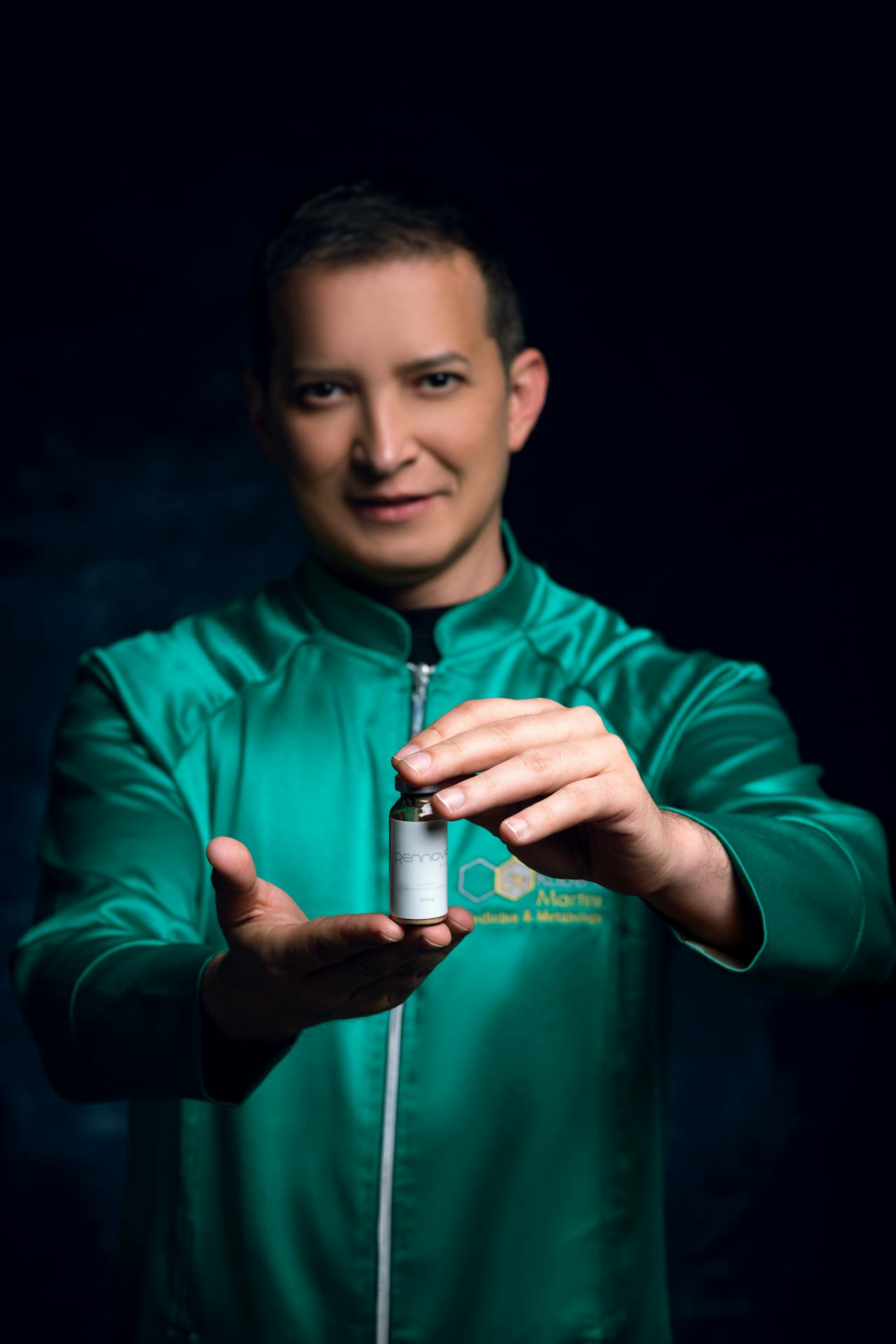
The short version: The GLOW blend combines three research peptides in a single vial: GHK-Cu, BPC-157, and TB-500, most often in a 70mg configuration containing 50mg of GHK-Cu, 10mg of BPC-157, and 10mg of TB-500. Each component has been studied separately in preclinical or clinical settings, but no published study has evaluated the three-peptide combination as a formulation. The blend is sold as a research-use-only laboratory chemical, not a medication. Alta Peptides publishes lot-specific certificates of analysis for its GLOW blend, which is the baseline standard any researcher should expect before ordering.
Search for “glow blend peptide” and you will find a market that has grown rapidly around a three-peptide stack that combines a copper peptide with two tissue-repair peptides. The individual components have well-documented research histories spanning dermatology, wound healing, and cell biology. The combination, however, has not been studied as a formulation, and many listings blur the line between what the literature supports for each peptide separately and what it claims for the blend as a whole.
This guide explains what the GLOW blend is, what the published research actually shows for each of the three components, why the combination has not been studied, and what documentation to verify before placing an order.
What the GLOW blend is
The GLOW blend is a fixed-ratio combination of three peptides: GHK-Cu (copper tripeptide-1), BPC-157, and TB-500 (thymosin beta-4 fragment). The most common configuration is a 70mg total vial containing 50mg of GHK-Cu, 10mg of BPC-157, and 10mg of TB-500. The blend is supplied as a lyophilised powder labelled for laboratory research use only.
The name derives from GHK-Cu’s documented role in collagen synthesis and skin remodelling, which is the component most associated with cosmetic and dermatological research. The Alta Peptides comparison of GLOW and KLOW blends explains how the two formulations differ and why the KLOW blend includes an additional component.
The individual components: what the research shows
GHK-Cu: the copper peptide with the strongest topical evidence
GHK-Cu is a tripeptide composed of glycine, histidine, and lysine, bound to a copper(II) ion. It occurs naturally in human plasma and declines significantly with age. A review published in the International Journal of Molecular Sciences in 2018 describes GHK-Cu as a small copper-binding peptide that modulates the expression of a wide range of genes involved in tissue remodelling, inflammation, and oxidative stress response.
Among the three components in the GLOW blend, GHK-Cu has the strongest human clinical evidence base, though the evidence is concentrated in topical applications. Cleveland Clinic’s overview of peptides for skin notes that GHK-Cu has been studied in topical formulations and that the evidence for injectable use is more limited.
The Alta Peptides comparison of topical and injectable GHK-Cu explains the differences in the evidence base for the two routes and why researchers need to be precise about which route a given study used.
BPC-157: preclinical evidence, no human trials for this indication
BPC-157 is a synthetic pentadecapeptide derived from human gastric juice protein. A review published in Cell and Tissue Research in 2019 examined BPC-157’s role in accelerating musculoskeletal soft tissue healing. The review found that BPC-157 was studied extensively in animal models for tendon, ligament, and muscle repair, but noted that human clinical trial data is lacking.
USADA’s athlete guidance on BPC-157 states plainly that there are no human clinical trials establishing efficacy for any diagnosis or treatment, and that because the compound has not been extensively studied in humans, it is unknown whether there is a safe dose. The FDA has placed BPC-157 in Category 2 of bulk drug substances that may present significant safety risks when used in compounding.
TB-500: actin regulation and cell migration research
TB-500 is a synthetic fragment of thymosin beta-4, a naturally occurring peptide involved in actin regulation and cell migration. A study published in the FASEB Journal examined the role of thymosin beta-4 in cell migration and tissue repair. The researchers found that thymosin beta-4 promotes cell migration by regulating actin dynamics, and that the peptide is upregulated in response to tissue injury. The study concluded that thymosin beta-4 plays a critical role in wound healing, though the research was limited to in-vitro and animal models.
TB-500 is studied in animal models for wound healing, cell migration, and inflammation modulation. Like BPC-157, it lacks published human clinical trials for musculoskeletal indications. The compound is prohibited at all times under the World Anti-Doping Agency’s Prohibited List.
Video: Have you heard of the GLOW stack?
This third-party video provides general context on the GLOW stack. It is not affiliated with Alta Peptides and is not a substitute for laboratory documentation or the published literature.
Why the combination has not been studied
The most important limitation of the GLOW blend is also the simplest to state: no published study has evaluated the three-peptide combination as a formulation. This means that the interaction between the three peptides, their combined stability in a single lyophilised vial, and their combined effects in any biological system are all unknown from a published-evidence perspective.
The Alta Peptides GLOW blend product page states this limitation explicitly and does not imply that the combination effects are established. A supplier that acknowledges the limits of the evidence for a combination product is operating at a different standard than one that implies the blend’s effects are the sum of its components.
For researchers, the practical implication is that the GLOW blend is a novel formulation in the research sense. Any experiment using it is testing a combination that has not been characterised in the published literature.
The researcher’s verification checklist
1. Lot-specific certificate of analysis for the blend
A certificate of analysis (COA) is only meaningful if it corresponds to the exact lot you are buying. For a blend, this is more complicated than for a single peptide. The COA should confirm the identity and quantity of each component in the blend, not just the total peptide content.
2. Component-specific identity results
A certificate for a peptide blend should include identity confirmation for each component. For the GLOW blend specifically, the identity confirmation should establish that all three peptides are present and match their reference standards. The copper content should be reported for the GHK-Cu component.
3. The research-use-only boundary
The RUO label means the product is not intended for diagnostic, therapeutic, or human use. What to watch for is a supplier that uses the RUO label while simultaneously publishing dosing information, before-and-after photos, or customer testimonials about human use.
4. Evidence disclosure
A trustworthy supplier discloses the limits of the evidence for a product. For the GLOW blend, that means stating clearly that the components are studied separately and that the combination is unstudied.
How Alta Peptides approaches GLOW blend documentation
Alta Peptides is a UK-based research peptide supplier that publishes lot-specific documentation for each product configuration. The company’s certificates page collects the reports for all products so that researchers can compare documentation across configurations.
The KPV product page is relevant for researchers interested in the KLOW blend, which adds KPV to the GLOW formulation. The copper and skin category organises the GHK-Cu and related products by research focus.
Comparing GLOW components
| Component | Research interest | Human evidence | Typical ratio |
|---|---|---|---|
| GHK-Cu | Collagen synthesis, matrix remodelling | Moderate for topical use | 50mg |
| BPC-157 | Angiogenesis, tissue repair | Preclinical only | 10mg |
| TB-500 | Cell migration, actin regulation | Preclinical only | 10mg |
| GLOW blend | Combination of the above | No combination studies | 70mg total |
Common questions about the GLOW blend
What is the GLOW blend made of?
The GLOW blend combines three peptides in a fixed-ratio vial: GHK-Cu (copper tripeptide-1), BPC-157, and TB-500. The most common configuration is a 70mg vial containing 50mg of GHK-Cu, 10mg of BPC-157, and 10mg of TB-500.
Has the GLOW blend been studied in clinical trials?
No. No published study has evaluated the three-peptide combination as a formulation. The individual components have separate research histories, with GHK-Cu having the strongest topical human evidence, but the blend itself has not been tested in clinical trials.
What purity should a GLOW blend COA show?
Purity by HPLC above 95 percent is the typical threshold for research-grade peptides. The purity figure is only meaningful alongside identity and content results. For a blend, the identity confirmation should establish that all three peptides are present and match their reference standards.
How do I verify that a GLOW blend COA is real?
Check that the testing laboratory is named and that the report ID can be cross-referenced. Some laboratories publish verification portals where a report ID can be entered to confirm the document’s authenticity.
What is the difference between the GLOW blend and the KLOW blend?
The GLOW blend contains GHK-Cu, BPC-157, and TB-500. The KLOW blend adds KPV to that combination. The naming reflects the components included.
What should I do if a supplier’s listing makes health claims?
Treat it as a disqualifying signal. Health claims on a research peptide listing are the exact pattern that regulators have cited in enforcement actions.
Important notice: This article is provided for educational and informational purposes only. It does not constitute medical, legal, or regulatory advice. Research peptides discussed here are sold exclusively for laboratory research use and are not approved by the MHRA, the FDA, or any other regulatory agency for human or veterinary use. Nothing in this article should be construed as guidance for human consumption, dosing, or administration. Researchers are responsible for complying with all applicable laws and regulations in their jurisdiction. Always consult the product label, the certificate of analysis, and a qualified professional before making decisions about any substance.